
Is it time for a total knee replacement?
A total knee replacement is an operation that replaces the worn surfaces of an arthritic knee with smooth, durable implants. It relieves pain and restores movement when other treatments have stopped working. Mr Ashwin Unnithan is a Consultant Orthopaedic Surgeon specialising in hip and knee surgery. He offers total knee replacement to patients across Surrey and South West London.
If knee arthritis is taking your sleep, your walks and your independence, that is the moment to talk. At your consultation, Mr Unnithan reviews your imaging with you and explains every option, including the non-surgical ones. Surgery is only recommended when it is genuinely the right next step.
With over ten years’ experience and a high surgical volume, Mr Unnithan offers both conventional and robotic-assisted knee surgery, using implants with strong long-term registry evidence. Your operation is planned around your own anatomy, activity level and lifestyle, not a standard template.
Updated for 2026 to reflect the National Joint Registry 22nd Annual Report and current NICE guidance (NG226) on osteoarthritis.
You might recognise these signs
- Knee pain that wakes you at night
- Stiffness after sitting, or a knee that will not fully bend or straighten
- Stairs, kerbs and getting out of a chair becoming a struggle
- Walking distance shrinking month by month
- Painkillers and injections no longer helping
- A knee that looks bowed or feels unstable
If any of these sound familiar, it is worth an honest conversation about whether a total knee replacement is right for you.
What is a total knee replacement?
A total knee replacement (also called total knee arthroplasty) resurfaces the damaged ends of the thigh bone and shin bone, and sometimes the back of the kneecap. Smooth metal and medical-grade plastic components take the place of worn cartilage. The result is a joint that moves without the bone-on-bone pain of advanced arthritis.
It is one of the most established operations in orthopaedics. The UK National Joint Registry has recorded more than 4.5 million procedures since April 2003, and its 2025 report shows a continued fall in revision surgery across joint replacement. The registry describes this as evidence that implants are lasting longer and outcomes are improving year on year.
NICE guidance (NG226) advises considering referral for joint replacement when non-surgical treatment is no longer effective and symptoms substantially affect quality of life. Mr Unnithan follows the same principle. Sensible non-surgical steps come first: physiotherapy, weight management, activity changes and injections. Surgery follows only when the balance clearly tips.
Not every arthritic knee needs a full replacement. When arthritis affects only one part of the joint, a partial knee replacement may preserve more of your natural knee. Mr Unnithan will advise which option suits you, based on your imaging and examination.
Why choose Mr Ashwin Unnithan for your total knee replacement in Surrey and South West London?
- Senior, experienced surgeon
Over ten years as a Consultant Orthopaedic Surgeon, with fellowship training in knee replacement surgery at St Albans City Hospital and in complex hip and knee replacement and revision surgery at the Royal National Orthopaedic Hospital.
- High-volume specialist
a busy practice covering straightforward and complex cases, including revision surgery, so the unexpected is met with experience.
- Robotic and minimally invasive options
robotic-assisted planning where suitable, alongside minimally invasive techniques aimed at less pain and a faster recovery.
- Evidence-based implant choice
implants selected for long-term performance on the National Joint Registry, not for fashion.
- Honest advice
you will be told plainly whether a total, partial or non-surgical route is best for your knee.
- Clinics across your area
main clinic at Parkside Hospital in Wimbledon, with further clinics in Kingston, Chertsey and Woking. Appointments are usually available within days.
- Recognised credentials
GMC 6040444, FRCS (Tr & Orth), and member of the Royal College of Surgeons, the British Orthopaedic Association and the American Academy of Orthopaedic Surgeons.
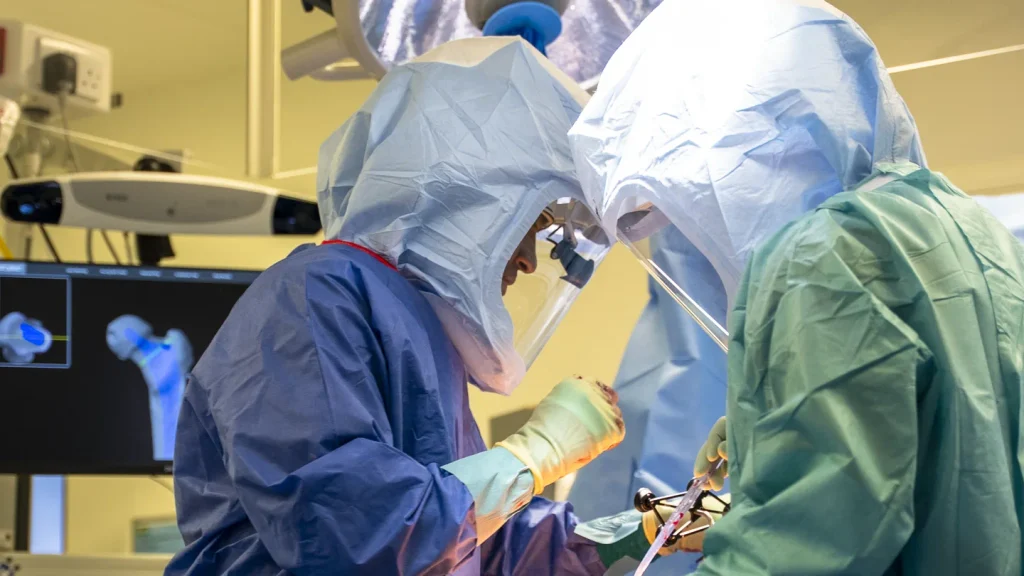
At a glance
Your treatment journey
Consultation & imaging
Weight-bearing X-rays, a thorough examination and an honest discussion of all your options, surgical and non-surgical.
Planning
If we proceed, you receive a personalised plan covering implant size, alignment and approach, with 3D robotic planning where suitable.
Surgery & recovery
Most patients stay one to two nights and are standing the same or next day, supported by an enhanced recovery programme.
Rehab & follow-up
Structured physiotherapy and scheduled reviews track your progress until you are back to the activities that matter to you.
- COMMON QUESTIONS
Frequently asked questions about total knee replacement
What is a total knee replacement, in simple terms?
It is an operation that replaces the worn surfaces of an arthritic knee with smooth artificial components. The aim is to relieve pain, improve movement and get you walking comfortably again.
How successful is a total knee replacement?
A systematic review in the HSS Journal covered 208 studies and 95,560 patients. It found that 83% of the studies reported satisfaction above 80%, with pain relief and function after surgery the main drivers. Results vary between individuals, so your own expectations are discussed openly at consultation.
How long does a total knee replacement last?
An earlier analysis citing National Joint Registry data reported that about 95.6% of primary knee replacements were still in place at ten years. The latest NJR report shows revision rates continuing to fall. Longevity depends on your age, weight, activity level and the implant chosen.
How painful is recovery after a knee replacement?
Pain is well controlled with modern anaesthetic and pain-management protocols. Swelling and stiffness are common in the first weeks, so physiotherapy matters as much as the operation itself. Most patients start with a frame or crutches, then progress to a stick, then to walking unaided.
When can I drive again after a total knee replacement?
Most patients return to driving around four to six weeks after surgery. The timing depends on which knee was operated on, your car and how well you control the leg. It is always confirmed at a follow-up review.
What is the difference between a total and a partial knee replacement?
A total knee replacement resurfaces the whole joint. A partial knee replacement treats only the damaged section and leaves healthy bone and ligaments in place. Suitability depends on which parts of your knee are affected.
Is robotic total knee replacement better than conventional surgery?
Robotic assistance helps plan and execute implant position and alignment from a 3D model of your own knee. It is not essential for every patient. Mr Unnithan will advise honestly on whether it adds value in your case. You can read more on our robotic-assisted surgery page.
Will my private medical insurance cover a total knee replacement?
Mr Unnithan is recognised by Bupa, AXA Health, Aviva, Vitality, Cigna and WPA. Cover depends on your individual policy, so check with your insurer before booking. If you are self-paying, you will receive a clear, itemised quote at consultation.
Do I need a GP referral to see Mr Unnithan?
No. A GP referral is not required for an initial consultation, and appointments are usually available within days.
Quick appointment request
We’ll call you back within one working day.
Handled in line with UK GDPR — used only to arrange your appointment.